
Monsters of the mind: the allegory of trauma and existential crisis IN NOLAN’S THE ODYSSEY
Written by Tara A. Henschel, M.D.
I recently saw Christopher Nolan’s 2026 epic The Odyssey, which retells Homer’s classic story of the Trojan War and Odysseus, one of its heroes, as he struggles to return home after years of conflict. The Greeks and Romans long regarded the epic as history, and recent archaeological evidence has offered some support for that view, lending the tale an added sense of reality. I first read The Odyssey in high school and remembered it as an exciting adventure filled with monsters, witches, and sirens, a thrilling sequence of dramatic encounters. After seeing the film in theaters, however, I noticed deeper and more familiar psychological themes beneath the action. The story carried far more emotional weight and moral complexity than I had recognized before. I now understand why the Greeks and Romans preserved it as part of their tradition: it remains a powerful cautionary tale about the costs of war and the vulnerabilities of human nature.
Having treated war veterans for more than a decade, I recognized the poignantly displayed psychological themes portrayed in the movie. Odysseus displays a mixture of pride, duty, and courage as both king and military leader when he joins King Agamemnon and his men to fight the Trojan War. He organizes the army by lot, attempts to make prudent decisions, and strives to present himself honorably before his troops. He fully appreciates the personal cost of war—the sacrifice of leaving his wife, young son, and kingdom behind to fight in a conflict from which he may never return. When he says, “The power of a sacrifice is in the cost to the one making it,” he underscores that giving up what is most precious to him is what makes the sacrifice meaningful to the gods and to his own conscience. Many service members enter the military with a comparable sense of honor and conviction, genuinely believing their sacrifices serve a greater good for humanity. Odysseus demonstrates how fate can play a role in who goes to war when he allows Sinon, a poor shepherd boy, to trade places with Antinous, convinced the arrangement will help support Sinon's father; yet this same choice—and other decisions made—later come back to haunt him, revealing the complex moral and psychological aftermath that soldiers often confront. He could have not foreseen that Sinon would be sacrificed as a spy in the Trojan Horse plot, and that Antinous would become glutinous and power-hungry seeking to court his own wife, kill his son and replace him as king.
Although his intentions are often good, he repeatedly sacrifices a few men to save the many — a grim calculus that seems logical in the immediacy of life-and-death moments yet sows deep conflict and guilt. For example, while escaping the cyclops Polyphemus’s cave, some men must be left behind to die as a diversion so the others can flee to safety. Upon piercing the cyclops’ eye, to their shock they discover he can speak; the monster cries out to his father Poseidon for help. That appeal summons Poseidon’s stormy, vengeful sea, and the crew must then endure a relentless, harrowing ordeal that underscores the tragic truth that even choices made to preserve life carry heavy consequences. Ironically, the very tactic intended to save people ultimately costs more lives later through the chain of retribution — a harsh example of how one apparent victory can provoke a cascade of seemingly endless wars.
Odysseus becomes his own worst enemy at times, blaming himself for the casualties of war and the misdeeds of his men. This theme is common among war veterans: intense, enduring guilt over battlefield decisions that resulted in loss of life, replaying choices endlessly and wishing they had acted differently. They may imagine alternative scenarios — that someone else should have been in a particular place instead, or that a fallen comrade had a family waiting at home while the survivor did not — and these intrusive thoughts can deepen and prolong feelings of shame and regret. This often presents as survivor’s guilt, a persistent, painful question of why they were spared when others were not. As a result, war veterans frequently struggle with depression, intrusive flashbacks and vivid hallucinations, recurring nightmares, and severely disrupted sleep patterns closely tied to memories of the fallen.
The imagery and scene used to represent these experiences are hauntingly vivid and beautifully poetic. When he asks the witch Circe how to find his way back home, she directs him to Hades, the underworld, instructing him to sacrifice a sheep and pour its blood into a bowl. When he follows her command, he is visited by the ghosts of the deceased soldiers who now dwell in Hades. He sees and speaks with Sinon, who bitterly accuses him of abandoning him in Troy and enabling the treacherous exchange with Antinous. He also encounters King Agamemnon, who warns him to trust no one, recounting how his own wife betrayed and murdered him. The theme of trust that emerges there becomes central to the hero’s struggle to return home, mirroring the profound difficulties many soldiers face when coping with reintegrating back into civilian life.
He is also haunted by the innocent priestess, played by Zendaya, who was viciously murdered and beheaded during the sacking and burning of Troy. Now he recognizes the barbarity of his and his men's actions during the battle and cannot easily shake those images. What he is experiencing resembles the moral injury commonly seen in war veterans: the wrenching awareness and guilt that come from participating in or witnessing appalling acts, especially the killing of civilians — many women and children — in senseless violence. It is all too common for soldiers to be tormented by such memories; I have known servicemembers who, after returning home, find that even looking at their own children they are suddenly reminded of the children who were killed in war. The death of the innocent appears to be the greatest price paid in battle, a loss that stuns the human mind and heart and raises the agonizing question of why the innocent must be killed so ruthlessly. I think this is a central struggle for Odysseus throughout the epic, particularly as he confronts the consequences of callous behavior, he once took part in.
Odysseus and his men, hungry and battle‑fatigued, anchor at several islands, searching only for food and hoping for kindness, but instead encounter brutal, unprovoked violence. They wander into the Cyclops’s cave, find a pouch of cheese, and begin eating, thinking only of sustenance and rest. Confident the owner will honor Zeus’s law and treat any beggar as a god in disguise; they decide to wait for him and accept hospitality. Instead, the Cyclops returns with his herd of sheep, and without a word picks up a soldier and brutally chomps him in half, announcing his cruelty with terrifying indifference. The Cyclops, who could symbolize a large, powerful, and single‑minded force, shows almost no foresight and lacks reasoning or communication; he acts entirely on instinct and brute appetite. This resembles a dominant army that fires first and asks questions later, relying on raw force rather than policy or persuasion. When the soldiers later learn he can speak, they are puzzled that he never tried to converse; the Greeks, who pride themselves as being philosophical and guided by reason, cannot understand why he did not use intellect to recognize their hunger and exhaustion. Rather than being shown mercy, they are treated as food and dismissed as mere prey. Ultimately, the Greeks outwit the Cyclops: his limited intelligence and habit of falling asleep quickly become his Achilles’ heel. They pierce his monocular eye, blinding him, and manage to flee, though they pay a heavy price in lost comrades.
Then they wander onto another island in search of food and encounter a boy whom they tell they are hungry and ask for food. He says nothing, but screams, and out come the Laestrygonian giants in suits of armor who ruthlessly and unrelentingly attack the men without speaking a word. Again many die, and the survivors narrowly make it back to the ship and sail away, shaken and bloodied. The same brutal pattern repeats: giants who do not reason or speak, but only kill. These trials deepen Odysseus’s and his soldiers’ growing disillusionment—proof that not everyone honors Zeus’s law, and that the world can be governed by blind violence rather than the golden rule of kindness unto others.
They eventually find someone who resembles their idea of hospitality, Circe, an older woman living alone in a quiet and secluded pastoral setting. When they tell her they are hungry, she graciously invites them in and, to their astonishment, assures them she has more than enough food. She seems accustomed to receiving visiting “sea people,” a recurring nuisance and burden to coastal communities. The soldiers are puzzled by how a woman in such a remote place could possess such abundance. They accept the offered soup, but it transforms them into swine. Later, Odysseus locates her house and notices one of his man’s rings, though the men themselves are nowhere to be seen; he refuses her food. He quickly recognizes that his companions have been altered, revealing Circe’s identity as a witch or sorceress. Circe insists that this transformation only exposes what they truly are at heart, arguing that left to their own devices they would lapse into animal impulses. This so-called “truth” conjures disturbing images about human nature and unrestrained gluttony. She reproaches them for failing to observe social customs—bringing a knife into the home and initially refusing hospitality—saying he and his men insulted her. Odysseus apologizes for the perceived offense, and she agrees to aid him, though he must first endure certain trials. The encounter highlights how imperialistic maritime peoples from across the Mediterranean have exploited local communities, a stark parallel to the aggressive suitors who have overrun his palace, brazenly demanding food and hospitality. There is also an ironic, poetic twist: Odysseus’s men nearly perish after accepting hospitality, just as Troy fell after accepting a deceptive gift.
He and his men's future tribulations are portrayed through the lens of divine punishment for their misdeeds. Odysseus is warned that all the men will die because of their own poor decisions, with the exception of himself. He appears to believe otherwise, convinced that he can somehow make the correct choices and steer his crew to safety as a leader. This allegory echoes the figure of a commander going into battle who trusts that his judgment alone can preserve all those under his command. Circe, however, understands more clearly that the men's own inherent moral weaknesses — impulsivity, lack of restraint, and failure to uphold civilized behavior — will ultimately be their undoing. Taken together, the scene points to a broader theme: humanity often engineers its own downfall through weaknesses of character and the abandonment of discipline and self-control.
Sadly, the prophecy proves true. Odysseus is warned by Circe that while on the island they must not eat the cattle because they belong to Zeus. The soldiers implore Odysseus to allow them to visit the island, and he consents only after they swear not to touch the cattle, a promise they manage to keep for a time. Eventually, however, their provisions run out and, driven by starvation, they steal away and slaughter the sacred animals for food. When Odysseus discovers what has happened, he is angered and disappointed; he tells them they may hide from him but cannot hide from the gods. This calls to mind the forbidden fruit from the tree of knowledge, underscoring the sinful impulse in the soldiers and, by extension, in humanity at large. Odysseus increasingly resembles a Moses figure, guiding his men through a perilous desert while the soldiers echo the Israelites in their persistent complaining and rebellion: when tested by hardship they panic and accuse their leaders of leading them to death in the wilderness. The same spiritual lessons surface here. Throughout the epic Odysseus seems to undergo a transformation into a more faithful, God-fearing man, but that growth comes at the cost of deep disillusionment with the world. Many veterans experience a similar spiritual awakening after witnessing the brutality of war, questioning what they fought for and struggling to reconcile the lack of virtue they find in civilian life.
Odysseus deliberately steers clear of the fatal whirlpool to preserve the crew as a whole, even though doing so forces the ship perilously close to jagged rocks where a few of the men are plucked out by the rock monsters to meet their death. Instead of being thankful, his men are grief-stricken, angry, and demand to know why he took them so close to the rocks despite the obvious danger. He insists it was the only possible course, following the prophet's warning and intent to save as many as he could, yet he cannot hide the sorrow in his voice as he recounts the impossible choice he faced. Still, doubt grows among the crew; they begin to question his judgment, muttering that there may be other motives or hidden knowledge he has not shared with them. It is another heavy burden Odysseus must bear as leader of these weary men.
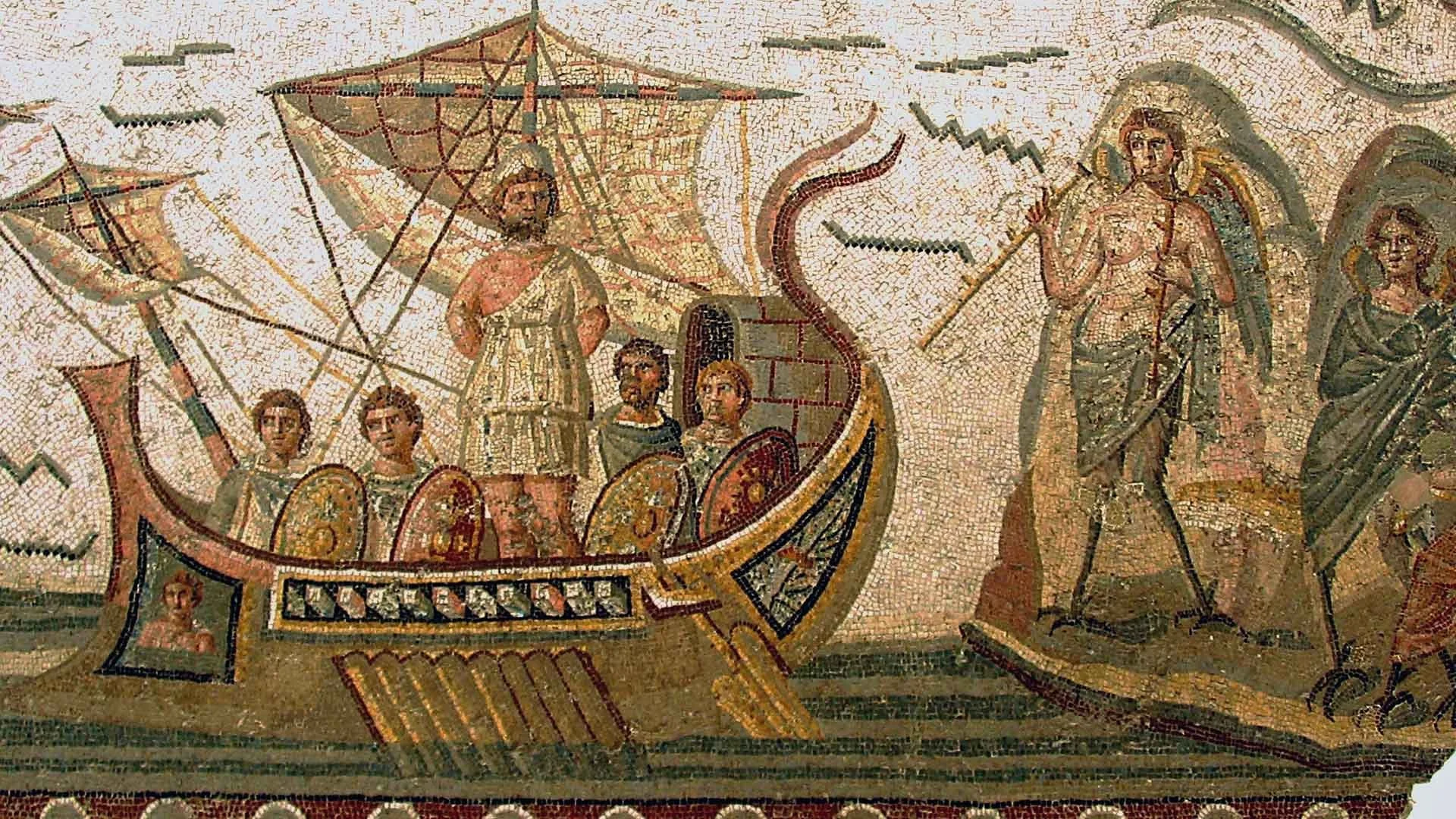
Another temptation they encounter is the Sirens of the Sea. Because the Sirens are depicted as feminine and enchanting figures whom the men cannot resist, this likely symbolizes the powerful pull of home and loved ones that all soldiers feel while away at war. We should remember that these men were away fighting for ten years and then spent another ten years struggling to return to the places and people they cherished. In ancient times, homesickness was a major cause of mutiny and desertion, as warriors spent many long years living in harsh camps and battle conditions without the daily comforts, family ties, and emotional support of home. Odysseus tries to prevent their desertion by having them tie him up and put wax in their ears, but as he shakes violently and seems to go mad, some lose hope, jump ship, and swim away toward the irresistible song.
Trust — or a lack thereof — also emerges strongly. Many veterans struggle with readjustment after returning home: they lose a clear sense of identity, suffer memory fragmentation from traumatic experiences, and find it hard to trust even their closest loved ones. This is evident in his attempts to piece together what happened, and in his uncertainty about his own purpose — he does not even understand why he built a raft only to let the sea carry him away. A common pattern with battle fatigue and depression is resignation: giving up, accepting death or fate, and behaving recklessly. He comes back and conceals his true self, keeping people at a distance and struggling to reintegrate into a society that feels uncivilized to him. Even with outward success, he feels alienated and believes he no longer belongs. He experiences the familiar veteran question — what did I sacrifice for? — and views society as immoral, undisciplined, and teetering toward collapse. He wanted the Odyssey to be preserved in song because he feared that the skills of reading and learning would disappear amid civilizational decline. Following blind Tiresias’ counsel, he embraces exile to cleanse himself of past misdeeds and to appease Poseidon. Likewise, many veterans cope with guilt and alienation after actions they have taken, choosing self-exile or avoidance as a way to manage reintegration.
The story is not only a tale of triumph in the Trojan War and of daring adventure, but also a deeper reflection on humanity’s recurring pitfalls. It functions as a sober cautionary account against the atrocities of war, brutal and uncivilized conduct, and immoral actions that offend the gods and gradually erode the fragile fabric of civilized life.